The Radiology Partners (RP) Body Imaging Subspecialty Division (NSD) presents our newest Rad to Rad Learning case.
Peer Learning Opportunity
This condition affects 1-2% of pregnancies. With associated bleeding, 1st trimester pregnancies are at a risk of up to 18%.
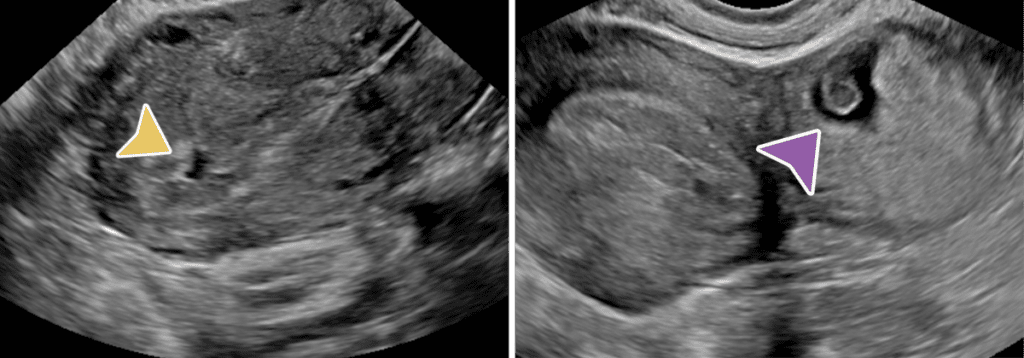
Ectopic Pregnancy: 93-97% of ectopics are tubal. Tubal ring sign has 95% PPV for ectopic. Visible double decidual sign of the intrauterine sac indicates low probability of ectopic.
Fluid in the endo canal is pseudosac (yellow arrow) vs. Ectopic (purple arrow)
Shared to improve patient safety and healthcare delivery in the provision of radiology services. The circumstances and facts are changed, altered, or deidentified to preserve confidentiality. Privileges have not been waived.
Practical Insights
Check for adnexal masses and amount of free fluid in the hepatorenal recess to determine significance.
Complex free fluid may represent blood products.
Quantitative beta HCG levels are required. Levels >2500 are highly suspicious for occult ectopic.
Surgery is recommended for ectopic >3.5cm or if cardiac activity is present.
Takeaway: Always report size of ectopic. If >3.5cm, surgery is recommended.
The Body Imaging Subspecialty Division(NSD)is part of RP’s Clinical Value Team, whichworks to elevate patient care and enhance value through innovation, collaboration and education.To advance this goal, our radiologists and advanced practice providers are committed to sharing peer learning as valuable reminders and insights about what weencounter in our day-to-day practice. Check back here and on X, LinkedIn and Instagram to see these common cases and our findings.
Visit the Clinical Resources page for more cases and to see what we’ve developed to enhance best practice recommendations, elevate image quality and patient care and update current standards throughout RP’s network of practices, all to deliver excellent radiology services to patients, referring clinicians and client partners.
Radiology Partners, through its owned and affiliated practices, is a leading physician-led and physician-owned technology-enabled radiology practice in the U.S. For the latest news from RP, follow us on X, LinkedIn, Instagram, YouTube and the blog.
Why RP? A Q&A with Dr. Syam Reddy, Body and Breast Radiologist
Dr. Syam Reddy, National Subspecialty Lead for Body Imaging at Radiology Partners (RP), discusses RP’s focus on delivering quality care and enhancing patient and client experiences while leading innovation in AI and technology.
Dr. Syam Reddy is the National Subspecialty Lead (NSL) for Body Imaging at RP. A body and breast radiologist and practice president at RP Chicago, he and his practice joined RP in 2014. He is the clinical chair at UChicago Medicine Ingalls Memorial and a member of several physician support boards, as well as a facilitator for coaching circles. He holds memberships in the Chicago Radiologic Society, Breast Imaging American College of Radiology (ACR) Data Science Institute, ACR CT colonoscopy committee, the ACR HR Commission, Society of Cardiovascular CT (SCCT) and Society of Cardiovascular MR (SCMR). Outside of work, Dr. Reddy enjoys spending time with family – traveling, playing tennis with his kids, and learning the cello.
We talked to Dr. Reddy about his role with RP’s Clinical Value Team as NSL for Body Imaging, RP’s commitment to quality and innovation, the role of collaboration and AI in advancing subspecialty practice, and his excitement about leveraging imaging technology like MosaicOS™.
What inspired you to be a radiologist?
The biggest reason is my mom was a radiologist. Towards the end of her career, teleradiology was becoming more common. She had this monstrous screen she would have to bring home, and I saw her read these head CTs that took forever to load. That inspired me to see the mix of computers and medicine and how they meld together to help the patient. The more I learned about it, I was drawn to the fact that it’s almost like looking at artwork, trying to decipher what’s going on and putting all the pieces together – you’re a little bit of a detective, too. I also like my hands in a little bit of everything, and I found radiology to be a field that really covers all the specialties to a great extent.
What drew you to body imaging as a subspecialty?
I like body imaging because it’s so integrated with everything – from ER to developing subspecialties. I also got involved with breast imaging quite a bit, so those are the two areas I focused on. I really enjoy learning, and in radiology, there are always new updates, information and trials.
Talk about your decision to join RP.
Our group was one of the earliest groups to join RP, way back in 2014. At the time, we were a fairly large group, with about 100 radiologists across four or five states. Our group landed with RP because of their focus on quality. RP’s mission to transform radiology includes improving quality, patient experience and client-side experience, which drew our attention. That’s exactly what we wanted. Being a physician who can be integrated and involved with that process is really meaningful.
Talk about the change and growth you’ve seen within RP since you joined in 2014.
Looking back, I think RP has positioned itself as a practice that’s ahead of the curve in several ways. We’re the ones helping the rural areas that can’t get help. We’re working with reimbursement issues to ensure physicians are getting reimbursed properly to maintain their practices. And we’re the practice that’s ahead of the curve when it comes to AI and technology. I see a lot of vendors coming out, but I don’t know how many are radiology-driven with the input that we have and the speed at which we are progressing. All of those really speak volumes about what we are doing, what we have done and where we’re going.
What was your path to serving on our Clinical Value Team as the National Subspecialty Lead (NSL) for Body Imaging?
I started out being on the subspecialty advisory board. After a couple years, our previous NSL decided to explore other opportunities and asked me if I wanted to get involved. I thought it was a good way to get further into the subspecialty. I was nervous at first, but it was fun to jump in and meet everybody in the body imaging group. I’ve really enjoyed meeting other people in the practice and seeing all the things that we’ve developed over the years. I think there’s so much more potential – just the vastness of radiology really needs guidance for all these subspecialty exams that we do. There’s so much information out there.
What has been the most rewarding aspect of your NSL work?
I think sometimes we can get somewhat siloed, even within our own groups. When we come together in our advisory boards and discuss topics like trauma, we’re all on the same page. Those conversations give us the chance to say, “We do that too,” “This is how we do it,” “This is a great idea,” or “Maybe we can tweak it this way.” That sharing of ideas is so powerful. It’s great knowing there are so many resources out there and different ways to connect with people. And then there’s the challenge of pulling information together in a concise way. There are so many books and articles, so you have to dig through information. We need to get to a point where everything is very concise and easy to access, because that’s the way of the future.
Talk about the “Rad to Rad” peer learning program. What is it and what’s the goal of it?
When we think of our residents and fellows, a lot of information today is short-form – quick snippets like a one- or two-minute video on YouTube or a one-pager. With that in mind, we created the “Rad to Rad” peer learning program. It’s simple: share a couple of images from an important case and highlight the most valuable points. It’s super easy, super quick and very high yield. That’s the kind of content people are seeing on social media when it comes to radiology cases. Our hope is that it draws the attention of residents and fellows – and also keeps all of us engaged. We’re all busy, but if we can take a minute or two to see a case that boosts our confidence or helps avoid a mistake, it’s worth it.
How do you and the Clinical Value Team come together to create “Rad to Rad” learnings?
All of us are exposed to different cases in our practice, and some of them stand out. For example, maybe it was a miss, or maybe it was a great catch. I think most of us have a process where we document that, whether it’s a teaching case or something else, and we’re all very passionate about our desire to showcase our subspecialty. Those are the kind of cases we present to each other in our board meeting when we’re working on this. It’s kind of a working meeting; we’ll share the case, and then people will bring up some pointers, verify if it looks accurate, etc. Being able to create that is rewarding by itself.
Why is a team like the Clinical Value Team so integral to the rapid technology changes?
We’re all racing to get our work done, but we need someone to pause and make sure we’re running in the right direction. Sometimes speed without guardrails or guidance can lead to chaos pretty quickly. RP’s Clinical Value Team provides a forum that allows us to still move fast, but in the right direction, and ensure we’re doing it safely for our patients and the radiologists. That is so important. Our radiology societies play a similar role by ensuring new information and literature reach radiologists, so the quality of practice is always improving. Medicine is changing so quickly, and so is technology.
How would you define a successful future?
It seems like there’s this ever-growing gap between the volumes of work and the supply of radiologists. One of the things we’re focusing on is AI and how we can integrate it with radiologists to improve the whole process. To me, success would be all of that coming to fruition: leveraging AI while maintaining our quality and improving patient care. If we’re able to see all those things happen, that’s true success – no question.
You are an early user of Mosaic Clinical Technologies™. What has your experience been so far?
My background is in biomedical engineering, and the biggest decision I had to make was whether to go into computers or medicine. The reason I didn’t go into computers is that I tend to obsess about trying to get things right. That’s why I enjoy working with MosaicOS™ – I like creating and understanding. It’s very early, but the concept of telling AI to handle tasks like calculating volumes or percent changes is just incredible. I used to do all of that manually with a calculator. What I really want to know is how far I can push the envelope. There are people who know more than I do, and I’m excited to learn from them. I think we’re headed in the right direction, and it’s going to be pretty amazing.
How would you like AI to help support your specialty?
I’ve always felt the purpose of RP’s Clinical Value Team is to make it easier to practice in our subspecialty: being faster, more efficient and with high-quality content. As we become more subspecialized, our subspecialized referrers expect very specific content. If we can increase everyone’s skill set in that way, then I think we’re successful. There’s a shortage of body imaging radiologists and breast imaging radiologists; how do we use AI and the clinical value we provide to decrease the gap while increasing the number of people who are able to perform?
Dr. Syam Reddy earned his medical degree from the University of Illinois Medical Center in Chicago; completed his residency at Sparrow Health System; and completed his fellowship in body MRI imaging at Baylor College of Medicine in Houston.
Radiology Partners, through its owned and affiliated practices, is a leading physician-led and physician-owned radiology practice in the U.S. Learn more about our mission, values and practice principles at RadPartners.com. For the latest news from RP, follow along on our blog and on X, LinkedIn, Instagram and YouTube. Interested in learning about career opportunities? Visit our careers page.
Rad to Rad Learning: Ovarian/Adnexal Torsion
The Radiology Partners (RP) Body Imaging National Subspecialty Division (NSD) presents our newest Rad to Rad Learning case.
The Body Imaging NSD is part of RP’s Clinical Value Team, whichworks to elevate patient care and enhance value through innovation, collaboration and education.To advance this goal, our radiologists and advanced practice providers are committed to sharing peer learning as valuable reminders and insights about what weencounter in our day-to-day practice.
Check back here and on X, LinkedIn and Instagram to see these common cases and our findings.Visit the Clinical Resources page for more cases and to see what we’ve developed to enhance best practice recommendations, elevate image quality and patient care and update current standards throughout RP’s network of practices, all to deliver excellent radiology services to patients, referring clinicians and client partners.
Radiology Partners, through its owned and affiliated practices, is a leading physician-led and physician-owned radiology practice in the U.S. For the latest news from RP, follow us on X, LinkedIn, Instagram, YouTube and the blog.Shared to improve patient safety and healthcare delivery in the provision of radiology services. The circumstances and facts are changed, altered, or deidentified to preserve confidentiality. Privileges have not been waived.
Rad to Rad Learning: Incidental Colon Cancer
The Radiology Partners (RP) Body Imaging National Subspecialty Division (NSD) presents our newest Rad to Rad Learning case.
The Body Imaging NSD is part of RP’s Clinical Value Team, whichworks to elevate patient care and enhance value through innovation, collaboration and education.To advance this goal, our radiologists and advanced practice providers are committed to sharing peer learning as valuable reminders and insights about what weencounter in our day-to-day practice.
Check back here and on X, LinkedIn and Instagram to see these common cases and our findings.
Visit the Clinical Resources page for more cases and to see what we’ve developed to enhance best practice recommendations, elevate image quality and patient care and update current standards throughout RP’s network of practices, all to deliver excellent radiology services to patients, referring clinicians and client partners.
Radiology Partners, through its owned and affiliated practices, is a leading physician-led and physician-owned radiology practice in the U.S. For the latest news from RP, follow us on X, LinkedIn, Instagram, YouTube and the blog.Shared to improve patient safety and healthcare delivery in the provision of radiology services. The circumstances and facts are changed, altered, or deidentified to preserve confidentiality. Privileges have not been waived.
Clinical Pathway: RP’s Clinical Value Team presents Best Practices for Bone Lesions
Radiology Partners published a Bone Lesion Clinical Pathway.
Dr. Neelesh Prakash serves as RP’s national subspecialty lead (NSL) for MSK imaging. Dr. Prakash partners with an advisory board made up of practicing radiologists to spearhead the development and implementation of programs with a mission to enhance clinical value and quality in MSK imaging across RP. They focus on refining best practice recommendations, advancing image quality and aligning with the latest industry standards, all to deliver innovation and excellence in radiology services for patients, referring clinicians and client partners, and they share resources, like this clinical pathway, broadly so that all practices can deliver high-quality subspecialty care to patients in their communities.
Radiology Partners Clinical Value Team exists to elevate patient care and enhance value through innovation, collaboration and education. Radiology Partners, through its owned and affiliated practices, is a leading physician-led and physician-owned radiology practice in the U.S. For the latest news from RP, follow us on X, LinkedIn, Instagram, YouTube and the blog.
Shared to improve patient safety and healthcare delivery in the provision of radiology services. The circumstances and facts are changed, altered, or deidentified to preserve confidentiality. Privileges have not been waived.
Clinical Pathway: RP’s Clinical Value Team presents best practices for Virtual CT Colonography
Radiology Partners recently created a Virtual CT Colonography Clinical Pathway.
Drawing on their extensive expertise, RP’s national subspecialty division (NSD) advisory board for body imaging collected practical guidance for virtual CT colonography (VC) programs including examples of workflows, order forms, patient prep and more. This reference material is geared to serve practicing radiologists and operational leaders when establishing and advancing VC programs at their institutions, which plays a crucial role in early detection and prevention of colorectal cancer.
Effective January 1, 2025, the Centers for Medicare & Medicaid Services (CMS) includes coverage for virtual CT colonography for colorectal cancer screening. Colorectal cancer is the the third most common cancer diagnosed in adults in the United States. This CMS decision marks a significant advancement, providing Medicare patients with access to a minimally invasive screening tool that can detect pre-cancerous polyps without anesthesia.
Dr. Syam Reddy serves as RP’s national subspecialty lead (NSL) for body imaging. Dr. Reddy partners with an advisory board made up of practicing radiologists to spearhead the development and implementation of programs with a mission to enhance clinical value and quality in imaging across RP. They focus on refining best practice recommendations, advancing image quality and aligning with the latest industry standards, all to deliver innovation and excellence in radiology services for patients, referring clinicians and client partners, and they share resources, like this clinical pathway, broadly so that all practices can deliver high-quality subspecialty care to patients in their communities.
Radiology Partners Clinical Value Team exists to elevate patient care and enhance value through innovation, collaboration and education. Radiology Partners, through its owned and affiliated practices, is a leading physician-led and physician-owned radiology practice in the U.S. For the latest news from RP, follow us on X, LinkedIn, Instagram, YouTube and the blog.
Shared to improve patient safety and healthcare delivery in the provision of radiology services. The circumstances and facts are changed, altered, or deidentified to preserve confidentiality. Privileges have not been waived.
Rad to Rad Learning: Abdominal Lymphadenopathy
The Radiology Partners (RP) Body Imaging National Subspecialty Division (NSD) presents our newest Rad to Rad Learning case.
The Body Imaging NSD is part of RP’s Clinical Value Team, whichworks to elevate patient care and enhance value through innovation, collaboration and education.To advance this goal, our radiologists and advanced practice providers are committed to sharing peer learning as valuable reminders and insights about what weencounter in our day-to-day practice.
Check back here and on X, LinkedIn and Instagram to see these common cases and our findings.Visit the Clinical Resources page for more cases and to see what we’ve developed to enhance best practice recommendations, elevate image quality and patient care and update current standards throughout RP’s network of practices, all to deliver excellent radiology services to patients, referring clinicians and client partners.
Radiology Partners, through its owned and affiliated practices, is a leading physician-led and physician-owned radiology practice in the U.S. For the latest news from RP, follow us on X, LinkedIn, Instagram, YouTube and the blog.Shared to improve patient safety and healthcare delivery in the provision of radiology services. The circumstances and facts are changed, altered, or deidentified to preserve confidentiality. Privileges have not been waived.
Why RP? Q&A with Dr. Jason Poff, Body Radiologist
Dr. Jason Poff discusses the unique opportunities and supportive environment at Radiology Partners that foster personal and professional growth and how RP is helping shape the future of radiology.
Dr. Jason Poff is a body radiologist based in Greensboro, North Carolina. As director of innovation deployment at Radiology Partners (RP), he works with RP’s clinical artificial intelligence (AI) team to identify and deploy the latest clinical AI models and other innovative technology to support RP radiologists in providing high-quality patient care. Outside of work, he enjoys being involved with his sons’ sports, spending time with family, long-distance jogging and reading. He joined RP in 2019.
We talked to Dr. Poff about the unique opportunities and supportive environment at Radiology Partners that foster personal and professional growth and how RP is helping shape the future of radiology.
What inspired you to become a radiologist?
I studied engineering as an undergraduate, and I still think of engineers as “my people” to this day. That’s how I process the world—I think like an engineer. When I was in college, I had an influential person in my life who was a physician. I was in chemical engineering specifically, which is all about building oil refineries and factories, and while I appreciated the problem-solving nature of it, it wasn’t as inspiring to me as taking care of people. It became clear to me in the middle of college that I wanted to go to medical school. I knew I wanted to pursue the field of radiology quickly, because it’s so adjacent to technology. Radiology feels like a frontier that’s moving the practice of medicine forward. It’s a dynamic field that’s always changing, and there’s always an opportunity to do something novel. I also really like the breadth of radiology and the fact that it touches every part of medicine – it’s not just one organ or just one type of malady. You need to be flexible with your knowledge and be able to have conversations with so many different types of physicians and patients.
What drew you to your subspecialty?
I did an abdominal imaging fellowship, but colloquially I say I’m a body radiologist. During training, my favorite thing about abdominal imaging was that I interacted with many different types of specialists. For me, I love to preserve flexibility in my career and have optionality. I appreciated that I could work with GI specialists, urologists or general surgeons. There are so many different directions, and I like the challenging aspect of having to master a variety of conditions. When I joined Greensboro Radiology, they actually hired me as a thoracic chest specialist, but they gave me the opportunity to learn on the job in an almost mini-fellowship with a former academic thoracic radiologist, Dr. Dan Entrikin, at Greensboro. I was fortunate in the kind of position I had at the time and the support I had to grow my specialty area.
How did you connect with RP?
I joined Greensboro Radiology in 2016, and Greensboro Radiology partnered with RP in 2019. We’ve had a lot of wonderful leaders in our practice who have been involved in RP from the beginning, and I’ve been able to learn from and see how their participation in RP benefited them and their careers. I am so appreciative of the personal growth I’ve experienced by becoming a leader at RP. RP has truly invested in me in a way that has allowed me to get out of my comfort zone. I love being a radiologist, but one of the things I really value at RP is being part of this team of people with a lot of different backgrounds. In addition to radiology, I work with people in creative branding, data scientists, IT experts, project management and people on the business and strategy side. It’s such a unique environment to be able to learn from all those people.
What’s most fulfilling about working as a radiologist at RP?
Number one, I’ve always felt RP was in a unique position to invest in the future for radiologists in a way that not many organizations or practices can do. With the expansive network of practices and the number of different domain experts RP invests in, that is difficult to find elsewhere in medicine, and the fact that it’s Radiology Partners—not just your hospital where you have to collaborate with many different stakeholders to make decisions about how to get new technology in your workflow—we’re just focused on radiology. That is such a unique position to be in, and it allows you to cut through red tape a lot of others face. We see that when we’re speaking with representatives from other institutions. Being at RP is just so unique, with its network, ability and intent to invest in transforming radiology. I see it as a once-in-a-career opportunity for me.
I also really value RP’s continued investment in physicians. I’ve benefited, but I’ve seen many people benefit, and it’s a huge range of opportunities. It’s one of the things I love to tell people about. RP will support you with everything from how to balance your career work-life balance to how to fight against burnout, and there are so many wonderful leaders who you can model yourself after. I think personally about Dr. Nina Kottler, associate chief medical officer for clinical AI, but also many people in leadership positions who you can emulate and grow with and from. When you’re drawing from a pool of talented people from the entire country, you are connected with some outstanding people to learn from.
What do you share with trainees when they ask you about working at RP?
It’s important to have the desire to seek out opportunities for growth as one of your primary career objectives. You’re always supposed to be one percent better than the person you were yesterday, right? To achieve that, you need opportunities, and RP provides so many ways to seek out those growth opportunities. It can be anywhere from the subspecialty leads to the culture and radiologist experience side; the business and strategy side to the sales side; the technology side. You can literally pursue anything that excites you or interests you in your career. It’s a special practice, and I’ve been able to learn from a lot of people with different expertise.
Talk about your role as director of innovation deployment at RP and how that applies to what you’re passionate about.
I feel fortunate in my role as a director in the AI space at RP. I was in the right place at the right time and found a wonderful mentor in Dr. Kottler and the other colleagues on my team. I don’t have a background in informatics. I’m just an engineer who loves radiology, and I’m persistent and keep showing up. I call myself an “AI junkie.”
But how does AI tie into abdominal imaging?
To me, AI is just an opportunity or a tool we arm ourselves with to be a better version of ourselves. That’s how I fundamentally think about AI. A lot of people have this fear of AI taking away our jobs, or they fear what it could potentially represent, but I see it differently. Just like we used the PACS system to move into the digital realm or like we used the dictaphone and voice recognition to get away from analog and move to digital, AI is another tool that levels us up as radiologists. It’s enabling us to take better care of our patients but also to do so in a way that makes the practice of medicine more sustainable and more enjoyable in an environment where we’re all extremely busy and have a lot of people who need our help.
What does the future of radiology look like, and how will RP contribute to that?
I am excited about the future of radiology because I think we’re at a pivot point now, in this place where there are many people who need our care. Imaging is helpful to people, and that’s why the demand increases every day. That’s not going to change, because in this environment where resources are limited, not just in radiology but in every medical specialty and throughout society, there’s a limitation on expertise and people who are well trained. Imaging is just going to grow in importance. That’s the reality, but there’s an opportunity now to shake up the paradigm. Personally, I think it’s a call to action. If we don’t define what the future of radiology is and carve that path through the challenges, someone else will. I see this as a huge opportunity. It’s a time where we need to apply ourselves, be creative and think about how technology can help us solve the challenges we face now.
What would you say to radiology trainees with that pivot point in mind?
I’d tell somebody who has 30-40 years of their career ahead of them to be thoughtful about joining an organization, practice or group of people that is committed to investing in the future. They need to be explicitly looking at addressing these challenges with unique solutions, and that’s going to involve technology and novel approaches to workflow and clinical solutions. Also, look for places that are dynamic and have a nimble mission statement. One of the things I love about Radiology Partners is that right up front, at the very top, they say they’re going to transform radiology. That is meaningful, because it’s literally setting the precedent that you should expect change, and that change is going to be essential to providing a high level of patient care and remaining a successful practice in the future. I like how it’s the very essence of the practice and the core theme. Change is not just an idea; it’s essential, and I think that’s only becoming more evident as we enter this dynamic where there’s this imbalance between capacity and demand of radiology services. In my opinion, the organizations committed to a culture of change are going to thrive.
With burnout being such a prevalent topic in medicine at large, do you have any observations on how do we confront burnout in the radiology space?
To me, burnout means you are lacking inspiration, so look for ways to feel inspired. Maybe inspiration is related to a sense of control over your environment. If you’re doing the same thing day in and out, that work just gets harder, and if you feel like you didn’t participate or aren’t connected to the decision-making process, that can manifest as burnout. Also, I would encourage you to seek new challenges or shake up your career in some way. Look for something different or for a new group of colleagues. They will help you to explore your interests and help you to understand why you were in that position that was leading to those feelings of burnout. Personally, this has given me a lot more energy in my career.
Anything else you’d like to share about your experience at RP?
I’m just thankful. RP is a unique practice. I’ve never been in a place where I could access people with such different backgrounds and grow as a person from it. I don’t have a business or strategy bone in my body,but I’ve been able to pick up thingsby being around others who work in those areas. It makes you look at the world in a way that makes you more creative and more flexible when challenges arise. Being able to connect with so many types of people is a real strength of RP.
Dr. Jason Poff earned his medical degree from Columbia University; completed his residency at the Hospital of the University of Pennsylvania; and completed his fellowship in abdominal imaging at the Hospital of the University of Pennsylvania.
Radiology Partners, through its owned and affiliated practices, is a leading physician-led and physician-owned radiology practice in the U.S. Learn more about our mission, values and practice principles at RadPartners.com. For the latest news from RP, follow along on our blog and on X, LinkedIn, Instagram and YouTube. Interested in learning about career opportunities? Visit our careers page.
Rad to Rad Learning: Colon Cancer Awareness
RP’s Body Imaging National Subspecialty Division (NSD) presents our newest Rad to Rad Learning case.
The Body Imaging NSD is part of RP’s Clinical Value Team, which works to elevate patient care and enhance value through innovation, collaboration and education. To advance this goal, our radiologists and advanced practice providers are committed to sharing peer learning as valuable reminders and insights about what we encounter in our day-to-day practice.
Check back here and on X, LinkedIn and Instagram to see these common cases and our findings.Visit the Clinical Resources page for more cases and to see what we’ve developed to enhance best practice recommendations, elevate image quality and patient care and update current standards throughout RP’s network of practices, all to deliver excellent radiology services to patients, referring clinicians and client partners.
Radiology Partners, through its owned and affiliated practices, is a leading physician-led and physician-owned radiology practice in the U.S. For the latest news from RP, follow us on X, LinkedIn, Instagram, YouTube and the blog.Shared to improve patient safety and healthcare delivery in the provision of radiology services. The circumstances and facts are changed, altered, or deidentified to preserve confidentiality. Privileges have not been waived.
Rad to Rad Learning: Abdominal Free Air
RP’s National Patient Safety Committee presents our first Rad to Rad Learning case.
The National Patient Safety Committee is part of RP’s Clinical Value Team, which works to elevate patient care and enhance value through innovation, collaboration and education. To advance this goal, our radiologists and advanced practice providers are committed to sharing peer learning as valuable reminders and insights about what we encounter in our day-to-day practice.
Check back here and on X, LinkedIn and Instagram to see these common cases and our findings.Visit the Clinical Resources page for more cases and to see what we’ve developed to enhance best practice recommendations, elevate image quality and patient care and update current standards throughout RP’s network of practices, all to deliver excellent radiology services to patients, referring clinicians and client partners.
Radiology Partners, through its owned and affiliated practices, is a leading physician-led and physician-owned radiology practice in the U.S. For the latest news from RP, follow us on X, LinkedIn, Instagram, YouTube and the blog.Shared to improve patient safety and healthcare delivery in the provision of radiology services. The circumstances and facts are changed, altered, or deidentified to preserve confidentiality. Privileges have not been waived.



 Takeaway: Always report size of ectopic. If >3.5cm, surgery is recommended.
 Visit the