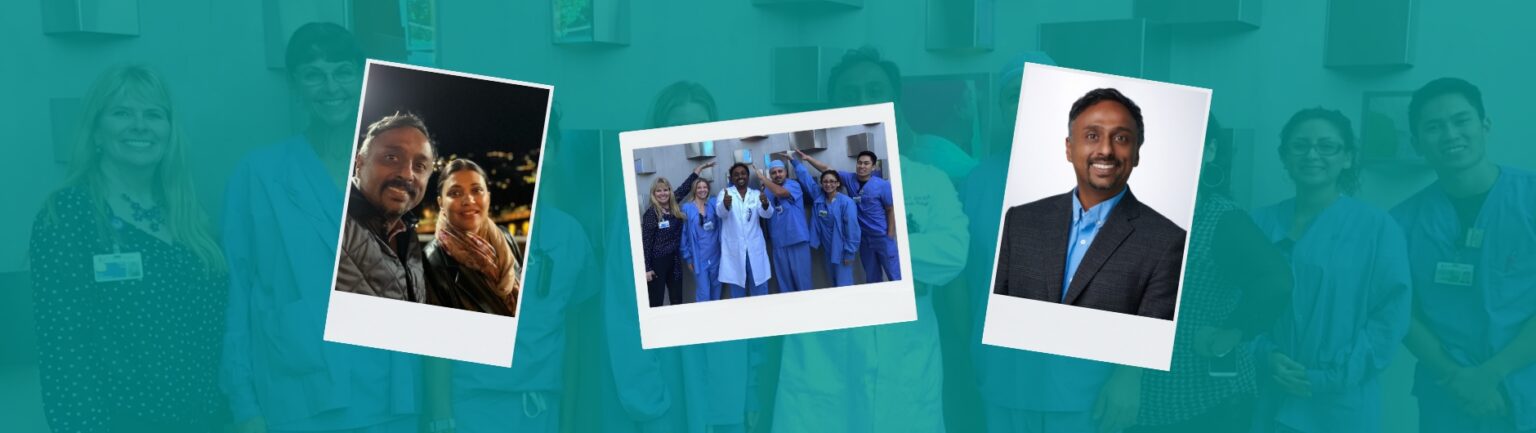
Dr. Arthy Saravanan, Associate Chief Medical Officer for Recruitment at Radiology Partners (RP), recently spoke with Dr. Ramesh Gopi, diagnostic radiologist and practice president of RP Silicon Valley.
Dr. Gopi discussed the benefits of RP’s support network, technology and resources – and how the support and flexibility allow him to maintain work-life balance. Read excerpts from their discussion below, and watch an extended version here.
Dr. Saravanan: How did you learn about RP, and what made you want to join?
Dr. Gopi: I did most of my training in Southern California, and Radiology Partners is headquartered in El Segundo. When I trained at UCLA, many of my colleagues ended up taking positions at RP practices, so I had some great feedback from them when my practice was scouting for groups to partner with. They had great things to say about RP regarding leadership, technology and operations, which really compelled the decision to look at RP seriously. We ended up partnering with RP in November 2020.
Now that you’ve been in the partnership for a couple of years, what was that transition like for you as a practicing radiologist before and after joining RP?
RP has a tremendous number of resources, including a large team of integrations specialists who help you think through the different steps of merging your practice with a larger entity. There’s literally a spreadsheet with 100 items on there and teammates who walk you through every single item because they’ve done this before. That makes the process very smooth. Each local practice has a practice director to help coordinate and orchestrate the entire process. Having never done something like this before, I can tell you single-handedly, we couldn’t have accomplished it, but as a team with RP, we were able to do it successfully over a few months.
Are there any significant things that stand out about being an RP radiologist?
RP brings so much to the table with its supportive network and access to resources. With so many radiologists, RP can still do an IT implementation in a week. They have their own teleradiology practice. They have many AI tools that can be implemented on-site and on-demand. They have partnerships with many other companies to help you implement a go-live very quickly. That came to bear two years after we merged with RP, when we expanded into another area where we took over a hospital contract. We saw how smoothly that process went.
How did you get into your role as practice president of RP Silicon Valley? Do you feel like there is support from the larger RP network to guide you in this leadership role?
I have a very interesting story. I started out as an engineer in Southern California and then decided to pursue medical imaging. After training, a colleague and I, as young radiologists, started a private practice in the San Francisco Bay Area and were able to assume the reins of a hospital contract in Silicon Valley. It was an exciting experience, and we learned a lot. We had to immediately grow into a leadership role to interface with hospital administration, billing companies and many other factions of people and resources, which lent itself to an organic development of leadership. RP has been great about honing that leadership in a more definitive way. As soon as we merged with RP, I got several calls from individuals in RP asking me to lead some AI initiatives, which led to me form relationships with these individuals, learn a lot about these technologies and ultimately bring those to our hospital. I’m very grateful to RP for being able to take this to the next level and help us improve our existing leadership capabilities.
What are your hobbies?
My real passion is coffee. I have a coffee bar at home, and I roast my own beans, make my own coffee and experiment a lot with that. We started this little cooperative with the technologists and hospital personnel and created a coffee bar inside an imaging center. Some of the technologists have learned how to become baristas. I also enjoy hiking. We live in a great neighborhood with ancient redwoods near us, so we can get there within a short period of time. I enjoy having people over; I grew up in a joint family in India, and that experience of being social really stayed with me.
How do you maintain your work-life balance, with your hobbies and your leadership roles at RP?
It is a challenge, but RP makes it easier by giving you the ability to work remotely. My mother recently had knee surgery, and I needed to keep an eye on her. I still wanted to work the daytime shift, so RP installed a workstation in my parents’ house, allowing me to read studies and check up on her. On the work front, RP has meetings and events throughout the year that help you mingle with other radiologists and get ideas from them. RP has really built a community around the whole concept of a large practice, which is great.
Talk to me a little bit about flexibility and burnout. With increasing volumes, radiologists are feeling a lot of pressure to read and keep up. How do you manage and deal with that?
I think we all go through it in different phases. All of us have exposure to events and things that make it a high-pressure environment. My whole philosophy is that happy radiologists will read films well. You have to find ways to de-stress and compensate for that pressure, and I think a lot of that comes down to having supportive colleagues – a great team, support teammates, practice directors and the backbone of an organization that can support you. RP offers Coaching Circles, which provide a way to share your thoughts in a forum and get life coaching on how to decrease stress levels. We have an associate chief medical officer, Dr. Chris Mattern, who is deeply involved in this. I often refer to his material in the hopes of improving the morale in our hospital. For example, during the pandemic, one local practice would get all the radiologists together and celebrate events like graduations and birthdays, just so that they had a chance to meet, even in a social vacuum. Things like that are really important, and we’ve tried to implement that, both with our own radiologists and also with support teammates and hospital partners. Those things help take the edge off the stress.
Dr. Ramesh Gopi earned his medical degree from the University of California, Irvine; completed his residency at UCLA Medical Center; and completed a fellowship in magnetic resonance imaging at the University of California, San Diego.
Radiology Partners, through its owned and affiliated practices, is a leading physician-led and physician-owned radiology practice in the U.S. Learn more about our mission, values and practice principles at RadPartners.com. For the latest news from RP, follow along on our blog and on X, LinkedIn, Instagram and YouTube. Interested in learning about career opportunities? Visit our careers page.